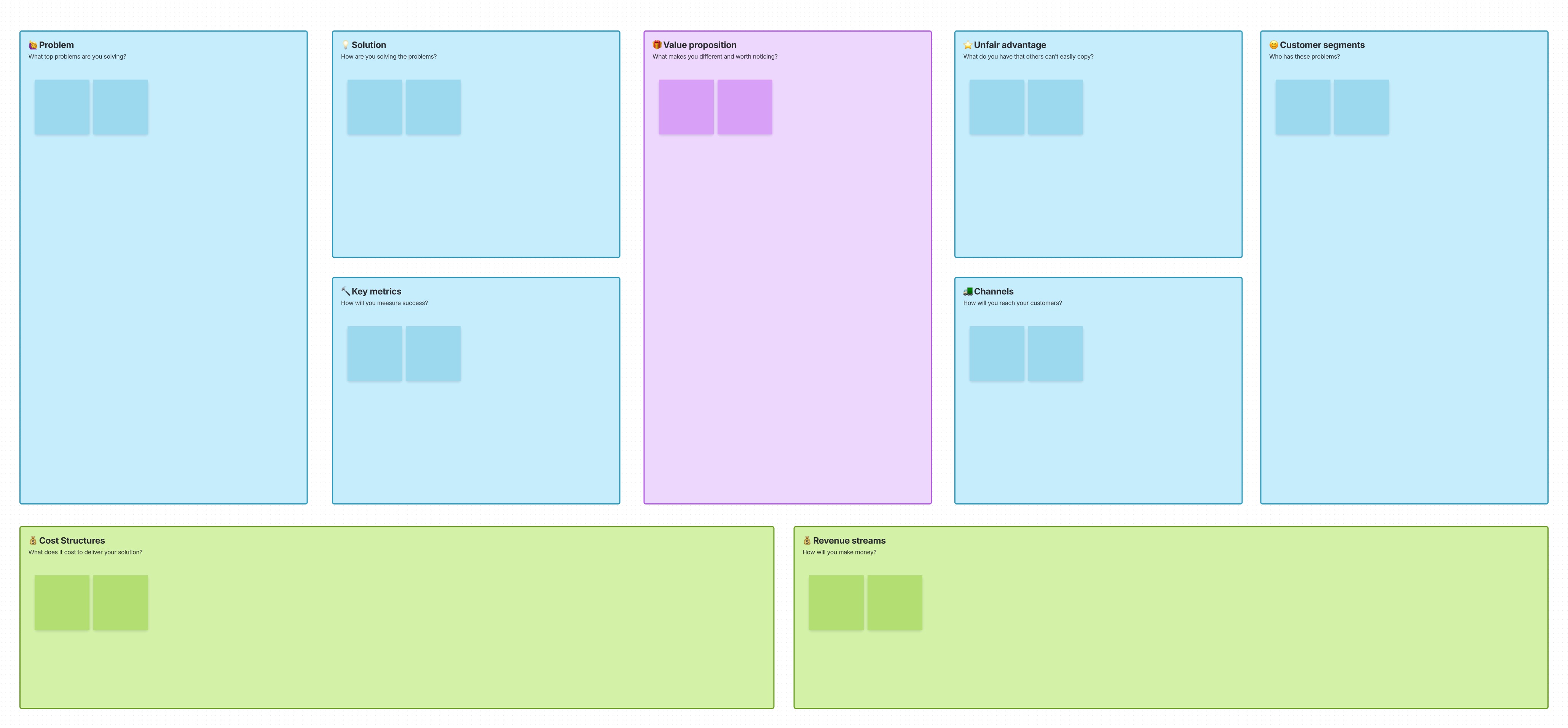
Lean canvas template
Created by:

Map out the core elements of your business model quickly and effectively
Categories
- Project Management
- Whiteboard Template
KEY FEATURES
Ideation
Goal Tracking
Documentation
The lean canvas template is designed for speed and clarity, helping startups and teams sketch out their business model on a single page. It captures the essentials of a business model without getting lost in spreadsheets or lengthy documents. Whether your goal is to validate a new idea or align your team, this template serves as a launchpad for agile, informed decision-making.
Instead of diving into long-form planning, the lean canvas template allows you to focus on what truly matters in a business's early stages—problems, solutions, key metrics, and customer segments. It’s a practical starting point for conversations, collaboration, and iteration.
What is a lean canvas?
The lean canvas, developed by Ash Maurya, is a one-page framework based on lean principles. It's designed to help entrepreneurs quickly and visually capture the most critical components of a business idea.
The lean canvas plays a pivotal role in early-stage startups by surfacing key assumptions and aligning teams around a shared vision. The structure breaks down a complex idea into four essential categories, each housing nine key elements of business planning, including problems, customer segments, key metrics, and revenue streams. This streamlined layout emphasizes clarity and speed, making it easier to test ideas, gather feedback, and adapt before investing significant resources.
Key elements of a lean canvas template
The lean canvas template is a strategic tool designed to help entrepreneurs, product teams, internal innovation projects, or anyone needing a fast, collaborative way to assess and iterate on new ideas into a clear and concise format. Based on the business model canvas and tailored for lean startups, it helps identify key assumptions quickly and efficiently, enabling faster learning and validation.
The lean canvas organizes nine essential elements into four broader categories to help teams focus on what matters most:
Problem: This category defines the core problem a product or service aims to solve and the specific customer groups who experience it. It covers the essential elements of the problem, including customer segments and early adopters, clarifying the market need and who it affects most.
Solution: This category proposes a solution to the problem and what makes it stand out in the market. It includes elements such as solutions, unique value propositions, and high-level concepts to ensure you accurately convey what you're offering and why it matters.
Channels: The channel category outlines how you plan to reach your customers and how your business will generate revenue. The essential elements here include channels and revenue streams, guiding decisions around marketing, distribution, and monetization.
Costs: This category captures the fundamentals of operation and performance. It includes the specific cost structure and key metrics, offering a high-level view of what it takes to run the business and how success will be measured.
By thoroughly mapping out these categories and their essential elements, entrepreneurs and teams can clearly understand their business plan for more strategic planning.
Lean canvas vs. business model canvas: Which should you use?
Both the lean canvas and the business model canvas help visualize a business plan on a single page — but they’re built for different purposes and stages of growth:
Lean canvas: The lean canvas is designed for early-stage teams or entrepreneurs working with uncertainty. It replaces financials and partnerships with startup-specific elements, like problem, solution, and key metrics, helping teams quickly test assumptions and iterate based on their learning. If your business is still validating its core idea or exploring product-market fit, the lean canvas offers the focus and flexibility you need.
Business model canvas: The business model canvas is more suitable for mature businesses or those ready to expand. It includes detailed components such as key partners, cost structure, and customer relationships, making it a better fit when your business model is more developed and your priorities include optimization, scaling, or external funding.
For example, a startup exploring a new product concept can use the lean canvas to identify and test risky assumptions before writing a single line of code. However, once that concept is validated and the team is preparing to scale, switching to the business model canvas provides a broader view of operations, partnerships, and infrastructure needed to grow sustainably.
In short, use a lean canvas template for speed and clarity during the idea stage and a business model canvas template for depth and planning as you scale.
Best practices for using a lean canvas model
The lean canvas is most effective when treated as a living document—one that evolves alongside the team’s understanding of the problem, customer, and market. Whether used by a solo founder or a cross-functional team, a few best practices can help maximize its impact.
Keep it simple: The lean canvas is meant to distill complex business ideas into their most essential components. Overloading it defeats its purpose.
Revisit regularly: Business assumptions change fast, especially in early-stage ventures. Lean methodology emphasizes continuous learning, which means revisiting the canvas is critical.
Validate with real input: One of the lean canvas’s main functions is to uncover and test risky assumptions. Validation through customer discovery and testing is key to reducing failure risk.
Collaborate early and often: Teams work better when everyone shares a common mental model. Visual tools like the canvas help cross-functional teams stay aligned.
Use it to guide priorities: The lean canvas surfaces what matters most. By referring back to it, teams can make consistent, strategy-driven decisions.
Test and iterate quickly: Speed is a core tenet of lean thinking. The canvas enables teams to sketch ideas, test them with minimal investment, and iterate based on feedback.
Drawbacks of using a lean canvas
Limits planning
The lean canvas focuses on high-level concepts, which may not be sufficient for long-term, detailed planning. It’s excellent for early-stage exploration but doesn’t capture financial projections, hiring plans, or operational workflows.
A startup can use the lean canvas to map out its business idea and clarify its initial strategy, but it will still need to develop a full business plan with detailed financial forecasts and growth milestones to meet investor or board expectations.
Confluence’s business plan one-pager template is the perfect solution for those with limited planning time.
Lacks customer validation
While the lean canvas prompts teams to identify key assumptions, it doesn’t include detailed validation or market research. As a result, teams might move forward on ideas without confirming real demand.
For example, a team may assume their target users face a specific problem, but they’ll still need to conduct interviews, run surveys, or test prototypes to validate that need and avoid building a solution based on guesswork.
Ignores market dynamics
The lean canvas doesn’t require a deep dive into evolving market conditions or competition. This can limit awareness of shifting customer behavior, new technologies, or emerging threats.
Consider a direct-to-consumer brand outlining its go-to-market plan. While the lean canvas can surface distribution strategies, the team still needs to supplement with competitive analysis and market trend research to stay relevant in a fast-moving space.
Doesn’t prioritize execution
The canvas defines the “what” of the business plan, but not the “how.” It doesn’t break down actionable steps or tactical plans for building and launching the product.
An entrepreneur can clarify their value proposition and customer segment using the canvas, but they will still need a product roadmap, a go-to-market timeline, and team roles to move from planning to execution.
Oversimplifies complex businesses
The simplicity of the lean canvas can be a drawback for companies with layered business models. Multiple revenue streams, diverse user segments, or regulatory considerations may not fit neatly into a single-page format.
A B2B SaaS company may use the canvas to define its core offering, but it will still need detailed documentation, such as persona-based workflows, pricing models, and compliance requirements, to support more complex operations.
Advantages of using a lean canvas
Identifies key risks
The lean canvas helps uncover the riskiest parts of your business model early, such as untested assumptions about customer needs or how you plan to solve their problems. By spotlighting these unknowns upfront, teams can validate them quickly and reduce the chance of building something customers don’t want.
For instance, a SaaS company, assuming its primary users are small business owners, can test this early by interviewing potential users and evaluating feedback. This approach ensures the product aligns with actual market needs before development begins, avoiding the risk of low adoption or early failure, which would result in wasted development effort.
Confluence’s risk assessment matrix template is available to help entrepreneurs and teams evaluate their market approach.
Defines the startup strategy
By laying out the entire business model on a single page, the lean canvas helps founders and teams clearly articulate their business strategy. It highlights the relationship between the problem, solution, and customer segments, aligning teams around a shared understanding of what they’re building and why.
A fintech startup focusing on underserved small businesses can use the lean canvas to connect its core problem — inefficient invoicing — with a simple, low-cost solution. This clarity enables the team to prioritize the features that matter most and ensure everyone is aligned on the go-to-market approach.
Streamlines communication
The lean canvas turns complex business ideas into a simple visual framework. With all key components laid out, the model becomes easier to communicate across teams and stakeholders. This clarity supports faster alignment, feedback, and decision-making.
Consider a hardware startup preparing for an investor meeting. The founder and team can use the lean canvas to quickly convey their target market, value proposition, and distribution strategy, helping stakeholders grasp the opportunity and ask better-informed questions from the start.
Encourages fast iteration
The lean canvas makes it easy to revise assumptions and experiment with different approaches as new information becomes available. The one-page format enables rapid changes to key elements —customer segments, pricing models, or value propositions—without overhauling the entire business plan. This flexibility allows teams to move faster and continuously improve based on feedback.
For instance, a SaaS startup shifting from a subscription model to a freemium tier can update its existing canvas or business plan to reflect this pivot. This allows the team to visualize the impact across customer segments and revenue streams and quickly test whether the new model improves user acquisition.
Simplifies decision-making
With all the critical elements of the business model in one place, the lean canvas helps teams weigh trade-offs and prioritize decisions quickly. It brings clarity to what matters most, such as customer needs, revenue potential, and cost structure, so teams can make faster, data-informed choices that move the business forward.
Let’s say an edtech team is debating whether to launch a student tool or a teacher dashboard. They can use the canvas to assess customer demand, monetization potential, and distribution strategy for each option. This high-level comparison makes it easier to choose the solution with greater impact.
How to create a lean canvas
- 1
Identify your problem
Start by defining the core problem your product or service solves by focusing on the top three pain points that directly impact your target customers. These problems should be specific, urgent, and worth solving, and will be the start of project collaboration for the team involved.
For instance, a team building a remote learning platform might identify poor engagement, lack of real-time feedback, and confusing content delivery as the key issues for online students.
- 2
Define customer segments
Clearly define who experiences these problems by breaking down your audience into distinct customer segments based on demographics, behavior, needs, etc. Each segment should be specific enough to guide product and marketing decisions.
One customer segment for a digital health app might include working professionals managing chronic conditions, while another target user could focus on preventive care.
- 3
Establish your unique value proposition
Describe what sets your solution apart and why customers should choose you over the potential alternatives. Your value proposition should directly tie to the target audience’s problem and address their top priorities.
For example, a task management tool might stand out by offering a minimalist design that reduces distractions for remote teams managing asynchronous work.
- 4
Outline your solution
Map out the core features of your product or service that solve the most prominent problems. Focus on what makes your solution effective and different, but be sure to focus on the essentials rather than a complete product spec. This might include specific tools, services, or workflows that directly address the top pain points.
Consider a budgeting app targeting freelancers. The app may highlight features like automated tax estimates, irregular income tracking, and smart invoice reminders. Alternatively, a logistics platform might focus on real-time delivery tracking, route optimization, and driver communication tools.
- 5
Analyze finances
Detail how your business will make money and where it will spend by outlining its primary revenue streams and cost structure to ensure financial viability. This enables founders and their teams to plan sustainably while staying lean.
For instance, subscription-based software might project monthly recurring revenue from users while accounting for costs like hosting, customer support, and development.
- 6
Finalize and update
Treat your lean canvas as a living document that thrives on continuous improvement. Update it regularly based on user feedback, testing, or market shifts. This continuous refinement, especially aftermarket assessments, ensures your strategy stays aligned with reality.
A travel startup might revise its customer segments after realizing its platform appeals more to remote workers than vacation travelers, updating both messaging and features accordingly.
Create a lean canvas in Confluence whiteboards
Visual collaboration with Confluence whiteboards allows teams to create, share, and evolve their lean canvas in real-time. Whether mapping out a lean startup canvas template or developing new ideas, whiteboards make it easy to capture, organize, and refine business concepts collaboratively. With an infinite canvas and intuitive drag-and-drop tools, teams can brainstorm freely, structure their thinking, and stay aligned on strategic priorities — all within a single shared workspace.
What makes Confluence and online whiteboards especially effective is how seamlessly they integrate with other popular collaboration tools. Teams can link sticky notes to related pages, track decisions, and build out documentation in one centralized platform. This means fewer context switches, smoother communication, and faster strategic planning.
Related templates

Business Strategy
Business plan template
The Business plan one-pager is used to set the medium- and long-term strategy for your company.

Startup
Product requirements document (PRD) template
Define, track and scope requirements for your product or feature.
Explore more templates to supercharge teamwork
Empower everyone, on every team. Build, connect, and deliver your biggest ideas seamlessly across Atlassian apps using our complete collection of ready-made workflows.